The History of Backgammon: From Before to Now
The entrancing allure of backgammon has captured the hearts and minds of strategists, gamblers and casual players alike for thousands of years. As one of the oldest board games still widely played today, backgammon offers a fascinating glimpse into human history, cultural exchange and the enduring appeal of games that balance skill and chance. This ancient pastime has weathered countless societal changes, technological revolutions and cultural shifts, yet remains fundamentally unchanged in its core mechanics since antiquity—a testament to its perfect design and universal appeal.
Ancient Beginnings: The Birth of Backgammon
Tracing the precise origins of backgammon presents a challenging historical puzzle. Archaeological evidence suggests that the earliest forms of backgammon emerged around 5,000 years ago in Mesopotamia—the cradle of civilisation between the Tigris and Euphrates rivers in what is now modern-day Iraq. Excavations at the Royal Cemetery at Ur, dating to approximately 3000 BCE, unearthed gaming boards that bear striking similarities to the backgammon boards we recognise today. These ancient gaming sets, with their carefully crafted playing pieces and distinctive board layouts, provide tangible evidence of humanity’s enduring love for strategic board games.
The Royal Game of Ur, as archaeologists named it, featured a board divided into squares rather than the triangular points we see on modern backgammon boards, but the fundamental concept of moving pieces according to dice rolls was already present. Players raced their pieces across the board, aiming to bear them off before their opponent—a core mechanic that remains central to backgammon today. You can explore reproductions of these ancient sets in our classic backgammon collection, which includes historically inspired designs alongside contemporary versions.
As civilisations flourished and trade routes expanded, similar dice-and-race board games appeared throughout the ancient world. The Egyptians played Senet, another race game that shared conceptual similarities with backgammon, while evidence of comparable games has been found in ancient China, India, and Persia. These early gaming traditions would eventually converge and evolve into what we now recognise as backgammon.
The Persian Connection: Nard and the Evolution of Backgammon
By the 6th century CE, a game called Nard (or Nardshir) had become immensely popular throughout Persia during the Sasanian Empire. According to Persian legend, the game was invented by the sage Buzurgmihr as a challenge from the Indian Raja who had sent the Persian King Khosrow I the game of chess. Nard represented the battle between fate and free will—the dice symbolising fate’s unpredictability, while player decisions represented human agency.
Nard featured many elements familiar to modern backgammon players: a board with 24 points, 15 pieces per player, and dice to determine movement. The positioning of pieces and the fundamental objective of bearing off all one’s checkers after moving them around the board were remarkably similar to contemporary backgammon rules. This Persian game would prove instrumental in spreading the backgammon concept westward through trade routes and cultural exchanges.
The name “backgammon” itself wouldn’t appear until much later, but the essential form of the game had taken shape by this period. Persian traders, soldiers, and travellers carried Nard throughout the Middle East, into North Africa, and eventually to Europe, where it would undergo further transformations.
Medieval Transformations: Tables and Taverns
As the game spread throughout the Byzantine Empire and into Europe during the early medieval period, it acquired various names and subtle rule variations. In Roman and Byzantine territories, it was known as Tabula (meaning “table” or “board”), while Anglo-Saxon England called it Taefl. By the Middle Ages, similar games were played throughout Europe under names like “Tables,” “Tric-trac” in France, and “Tavola Reale” in Italy.
Medieval European manuscripts and artwork frequently depict nobility and commoners alike engaged in games of Tables. The game’s popularity transcended social boundaries—played in royal courts and humble taverns with equal enthusiasm. In England, Tables became so widespread that it featured prominently in the Alfonso X manuscript of 1283, a compendium of games commissioned by King Alfonso X of Castile. This detailed documentation helped standardise rules and preserve the game for future generations.
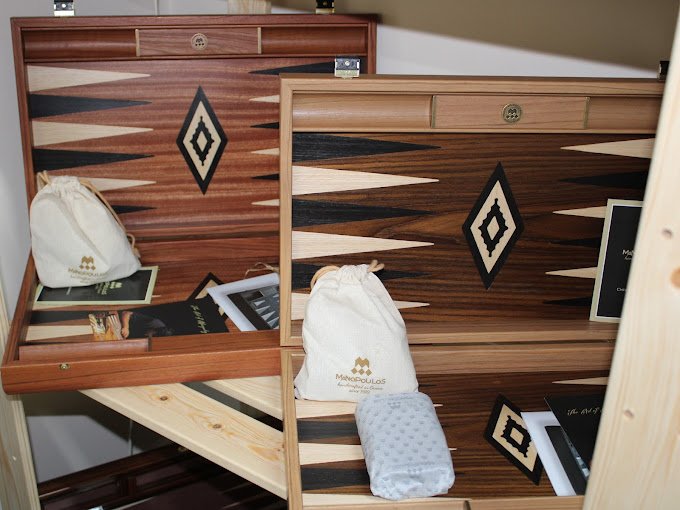
During this period, the game evolved not just in terms of rules but also aesthetically. Medieval and Renaissance craftsmen created exquisite gaming boards using precious materials—inlaid wood, ivory, gold, and gemstones—transforming backgammon sets into status symbols for the wealthy. For enthusiasts of these ornate designs, our luxury backgammon range captures the spirit of these historical masterpieces with contemporary craftsmanship.
Despite occasional religious opposition to games of chance in medieval Europe, backgammon’s blend of skill and luck helped it survive periods when pure gambling games faced prohibition. The strategic elements elevated it above mere games of chance in the eyes of many authorities, allowing it to flourish where other dice games were suppressed.
The English Renaissance: Backgammon Gets Its Name
It wasn’t until the 17th century that the term “backgammon” emerged in English literature. The first recorded use appears in 1645, though the exact etymology remains disputed. Some scholars suggest it derives from “back” and “game,” referring to pieces going “back” into the game after being hit. Others propose a Welsh origin from “bach” (little) and “cammaun” (battle). Regardless of its linguistic roots, the name stuck, and “backgammon” gradually replaced “Tables” in English-speaking countries.
The English Renaissance period saw backgammon firmly established as a fashionable pastime among the aristocracy and an everyday diversion for the working classes. Coffee houses, which emerged as social hubs during this era, often featured backgammon boards alongside chess sets and playing cards. The game’s perfect balance of accessibility and depth made it appealing across educational and social divides.
During this period, the rules began to standardise closer to those we recognise today. The introduction of the doubling cube—a critical innovation in competitive backgammon—wouldn’t occur until centuries later, but the fundamental mechanics of movement, hitting, and bearing off were largely settled by this time. The essential character of backgammon as we know it had formed, though regional variations continued to flourish.
The Colonial Spread: Backgammon Goes Global
As European powers established colonies around the world, they brought their cultural pastimes with them. Backgammon travelled aboard merchant ships and in the luggage of colonists, finding new enthusiasts across the globe. In America, backgammon quickly established itself in the homes of early settlers, becoming particularly popular among the educated classes in New England.
The 18th and 19th centuries saw backgammon spread to the far corners of the British Empire. Colonial administrators in India played backgammon in hill stations during the monsoon season, while traders in Hong Kong and Singapore introduced the game to local elites. In each new setting, backgammon sometimes incorporated local aesthetics and occasionally fused with indigenous gaming traditions, creating regional variants.
This global diffusion contributed to backgammon’s remarkable cultural adaptability. From the Plakoto, Fevga, and Portes variants popular in Greece to the Tapa variation played in Bulgaria, backgammon demonstrated an uncanny ability to adapt to local preferences while maintaining its essential character. For those interested in exploring these international versions, we offer comprehensive guides to backgammon variants on our website.
The Modern Revolution: Doubling Cube and Tournament Play
The most significant innovation in backgammon’s recent history came in the 1920s with the introduction of the doubling cube. This simple six-sided die, numbered 2, 4, 8, 16, 32, and 64, revolutionised the game by allowing players to increase the stakes during play. The doubling cube transformed backgammon from a lengthy contest of attrition into a more dynamic game where psychological warfare and risk assessment became paramount.
The exact origins of the doubling cube remain somewhat mysterious, though most historians attribute its invention to players in private clubs in New York City’s gaming scene. By the 1930s, the doubling cube had become standard in American backgammon, and its use quickly spread to Europe and beyond.
The mid-20th century witnessed another significant development with the emergence of organised tournament play. The World Backgammon Championship, first held in Las Vegas in 1967, helped establish standardised rules and brought together elite players from around the globe. These tournaments, combined with the publication of instructional books by champions like Paul Magriel and Bill Robertie, elevated the game’s strategic understanding and public profile.
For those looking to develop their competitive edge, our tournament backgammon strategies guide offers insights from experienced players and tournament veterans.
The Digital Age: Backgammon Meets Computing
The late 20th century brought perhaps the most profound transformation to backgammon since its ancient origins: the application of computer analysis. In 1979, the backgammon program BKG 9.8, developed by Hans Berliner at Carnegie Mellon University, defeated the reigning world champion Luigi Villa in a historic match. This milestone demonstrated that computers could successfully tackle games combining skill and chance—not just deterministic games like chess.
The development of neural network algorithms in the 1990s further revolutionised backgammon theory. TD-Gammon, created by Gerald Tesauro at IBM, taught itself to play at an expert level through self-play and reinforcement learning. These programs revealed optimal strategies that sometimes contradicted conventional wisdom, leading to a fundamental reassessment of backgammon theory at the highest levels.
Today, backgammon software like GNU Backgammon, XG (eXtreme Gammon), and Snowie allow players to analyse their games with astonishing precision. These programs calculate the exact equity of each possible move, highlighting missed opportunities and strategic errors. For serious players, this technology has accelerated improvement and deepened strategic understanding in ways that would have been impossible in previous eras.
The internet age has further democratised access to backgammon. Online platforms allow players from different continents to compete instantly, while forums and social media groups facilitate knowledge sharing among enthusiasts. For newcomers looking to join this digital community, our guide to online backgammon resources provides excellent starting points.
Contemporary Renaissance: Backgammon in the 21st Century
The 21st century has witnessed something of a backgammon renaissance. While the digital age threatened to relegate physical board games to history, the opposite has occurred—there’s been a resurgence of interest in tangible gaming experiences. Luxury backgammon sets have become coveted design objects, with contemporary craftspeople creating boards that rival their historical counterparts in beauty and craftsmanship.
This revival extends beyond aesthetics. Tournaments continue to thrive worldwide, from the World Backgammon Championship in Monte Carlo to local club competitions. The UK Backgammon Federation and similar organisations around the world promote the game through organised play, educational initiatives, and community building.
The COVID-19 pandemic, for all its challenges, further accelerated backgammon’s popularity as people sought engaging indoor activities during lockdowns. Many discovered or rediscovered the game’s perfect balance of accessibility, depth, and social interaction—qualities that have sustained backgammon for millennia.
Today’s backgammon landscape is remarkably diverse. Traditional wooden boards share space with innovative designs in acrylic, leather, and metal. Players might learn from ancient strategy manuals or cutting-edge AI analysis. Tournaments feature both venerable grandmasters and young prodigies. For those looking to join this vibrant community, our beginner’s guide to backgammon offers an excellent introduction.
Conclusion: The Timeless Appeal of Backgammon
From ancient Mesopotamian palaces to modern smartphone screens, backgammon’s journey spans civilisations, continents, and technological revolutions. Few cultural creations can claim such remarkable longevity and persistent relevance. What explains this enduring appeal?
Perhaps it’s the perfect mathematical balance at backgammon’s core—the game offers enough randomness through dice to give novices a fighting chance, yet sufficient strategic depth to reward decades of study. Perhaps it’s the game’s social nature—backgammon creates natural opportunities for conversation, wagers, and camaraderie across age and cultural divides. Or perhaps it’s simply the satisfying tactile experience of moving pieces, rolling dice, and bearing off that final checker.
Whatever the explanation, backgammon’s remarkable journey from the ancient world to contemporary society shows no signs of ending. As new generations discover its pleasures and challenges, backgammon continues to evolve while remaining fundamentally unchanged—a living museum piece that never stops being relevant, engaging, and thoroughly enjoyable.
For those inspired to begin or continue their own backgammon journey, House of Classic Games offers everything from beginner-friendly sets to tournament-quality boards, alongside resources to help players of all levels deepen their appreciation of this magnificent game. After all, when you play backgammon today, you’re participating in a tradition that connects you to countless players across five millennia of human history—a compelling thought to consider during your next game.