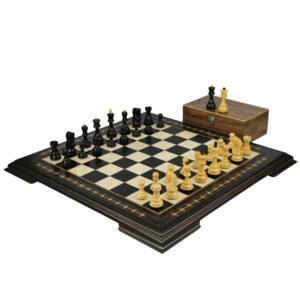
The History of Chess: From Past to Present
Chess, often referred to as the game of kings, has captivated minds across the globe for centuries. Its rich tapestry of strategy, intellect and cultural significance extends far beyond the sixty-four squares upon which it is played. The journey of chess through time reflects not merely the evolution of a board game, but rather the development of human thought, military strategy, and social hierarchies across diverse civilisations.
Ancient Origins: The Birth of Chess
The precise birthplace of chess remains somewhat shrouded in mystery, though most scholars point to the Indian subcontinent as its likely cradle. Around the 6th century AD, a game called chaturanga emerged in Northern India, featuring pieces representing various military units: infantry, cavalry, elephants, and chariots. This early prototype laid the foundational structure for what would eventually become modern chess.
Chaturanga’s name itself derives from the Sanskrit term for the four divisions of the Indian army. Unlike today’s chess, which is strictly a two-player affair, some variations of chaturanga accommodated four participants, each controlling their respective armies positioned at the four corners of the board. The movement of pieces bore striking similarities to contemporary chess, though certain elements differed substantially.
The game’s spread from India followed ancient trade routes and military conquests. As it travelled westward into Persia (modern-day Iran) around the 7th century, chaturanga underwent its first significant transformation. The Persians renamed it chatrang and began refining both its rules and terminology. It was during this Persian chapter that we first encounter terms that would eventually evolve into familiar chess vocabulary—the Persian expression “shah mat” (the king is helpless) would later become “checkmate” in English.
The Islamic Golden Age: Chess as Science and Art
Following the Islamic conquest of Persia in the 7th century, chess found itself absorbed into the flourishing intellectual culture of the Arab world. Renamed shatranj, the game became immensely popular throughout the Islamic empire, stretching from Spain to India. During this period, chess transcended its status as mere entertainment to become a subject of serious intellectual pursuit.
The earliest chess manuscripts and problem compositions date from this era. Arab scholars produced elaborate treatises analysing openings, tactics, and endgame strategies. Players such as al-Adli and as-Suli achieved considerable fame for their chess prowess and theoretical contributions. Chess problems, known as mansubat, became a sophisticated art form, with compositions prized for their elegance and complexity.
Chess during the Islamic Golden Age remained somewhat slower and more deliberate than its modern counterpart. The queen (then called the vizier) moved only one square diagonally, making it considerably weaker than today’s piece. The bishop (called alfil, meaning “elephant”) could only move exactly two squares diagonally, jumping over the intervening square. These limitations resulted in games that often developed gradually, with breakthrough victories requiring careful planning and precise execution.
Medieval Europe: Chess Transforms
Chess arrived in Europe through multiple channels—via the Moorish conquest of Spain, through Italy’s trade connections with Byzantium, and through the Crusaders’ encounters with the Islamic world. By the 10th century, chess had established footholds across the continent, appearing in manuscripts from Spain, Italy, and Germany.
European players gradually modified the Persian-Arabic version of the game. The most dramatic transformation occurred in the late 15th century with the emergence of modern chess in Southern Europe. The queen’s powers were vastly expanded, allowing it to move any number of squares in any direction, instantly transforming it from one of the weakest pieces to the most formidable. Similarly, bishops gained their current ability to traverse any number of squares diagonally.
These rule changes dramatically accelerated the pace of chess, enabling swift attacks and dynamic strategies previously impossible. Some chess historians have suggested these changes reflected shifting social realities in Europe, particularly the rise of powerful queens like Isabella of Castile. The modernised game spread rapidly across Europe, with the new rules documented in published works such as the Göttingen manuscript (circa 1500) and Luis Ramírez de Lucena’s Repetición de Amores y Arte de Ajedrez (1497).
Medieval European chess also acquired rich cultural associations. Chess pieces were often luxuriously crafted from ivory, crystal, or precious metals, serving as status symbols for nobility. The game featured prominently in courtly literature, such as the 13th-century Libro de los juegos (Book of Games) commissioned by Alfonso X of Castile. Chess metaphors permeated medieval thought, with the chessboard symbolising the ordered cosmos and different pieces representing the social estates.
Renaissance to Enlightenment: Chess Becomes Systematic
The Renaissance period witnessed chess’s transformation from a courtly pastime into a subject of systematic study. The earliest printed chess books appeared in this era, including works by Portuguese author Pedro Damiano and Spanish priest Ruy López de Segura, whose name lives on in the popular Ruy López opening.
By the 17th century, coffee houses in European cities had become vibrant centres of chess activity. London’s Slaughter’s Coffee House and Paris’s Café de la Régence emerged as informal chess academies where players of various social backgrounds could test their skills. These establishments fostered a competitive chess culture and helped standardise rules across national boundaries.
The 18th century brought further refinement to chess theory and practice. François-André Danican Philidor, a French musician and chess master, published his influential L’Analyse du jeu des Échecs (Analysis of the Game of Chess) in 1749. Philidor’s famous dictum that “pawns are the soul of chess” revolutionised strategic thinking, emphasising pawn structure as a crucial element of position evaluation. His emphasis on strategic planning rather than merely tactical combinations marked a significant maturation in chess understanding.
The 19th Century: Chess Becomes Organised
The 19th century represented a watershed moment in chess history, as informal play gave way to organised competition. The first major international chess tournament was held in London in 1851, with Adolf Anderssen of Germany emerging victorious. This event set a precedent for regular international competitions, fostering a sense of chess as a serious competitive pursuit.
The era produced legendary players such as Paul Morphy, the American prodigy who dominated European opposition during his brief competitive career, and Wilhelm Steinitz, who became the first officially recognised World Chess Champion in 1886. Steinitz’s theoretical contributions were as significant as his playing achievements; he articulated the principles of positional play and accumulated advantage that form the foundation of modern chess strategy.
Chess clubs and national associations proliferated during this period. The British Chess Association was founded in 1862, while similar organisations emerged across Europe and America. These institutions helped standardise rules, organise tournaments, and publish chess literature. Mechanical chess clocks, introduced in the 1880s, allowed for better time management in competitive play and became a fixture of tournaments.
The aesthetic sensibilities of 19th-century chess favoured daring sacrifices and brilliant combinations. Games like the “Immortal Game” (Anderssen vs Kieseritzky, 1851) and the “Evergreen Game” (Anderssen vs Dufresne, 1852) exemplified the romantic style that captivated chess enthusiasts of the period. This approach would eventually give way to more methodical, scientific approaches in the following century.
The Soviet Chess School and the Cold War Era
Following the Russian Revolution, chess acquired unprecedented state support in the Soviet Union. The Bolshevik leadership, particularly Nikolai Krylenko, recognised chess as an inexpensive form of recreation that could enhance intellectual development while demonstrating Soviet cultural prowess internationally. Chess clubs were established in factories and community centres, creating a vast infrastructure for talent identification and development.
This systematic approach bore fruit with the emergence of formidable Soviet players like Mikhail Botvinnik, who became World Champion in 1948 and pioneered a scientific approach to chess preparation. The “Soviet School of Chess” emphasised thorough opening analysis, physical fitness, and collective training methods. From 1948 until the collapse of the Soviet Union, Soviet players dominated the World Championship, interrupted only by American Bobby Fischer’s dramatic victory over Boris Spassky in 1972.
The Fischer-Spassky match, played against the backdrop of Cold War tensions, transcended chess to become a symbolic confrontation between competing political systems. Fischer’s brilliant play and eccentric personality captured global attention, triggering a chess boom in the West. However, his subsequent withdrawal from competitive chess and descent into reclusion cut short what might have been an even more illustrious career.
The Computer Age: Silicon Challenges Human Dominion
The relationship between chess and computing extends back to the earliest days of computer science. Alan Turing developed the first chess algorithm on paper in 1950, before even having a computer powerful enough to run it. As computing technology advanced, chess programs gradually improved, though for decades they remained vastly inferior to skilled human players.
The watershed moment came in 1997 when IBM’s Deep Blue supercomputer defeated World Champion Garry Kasparov in a six-game match. This event marked a psychological turning point, demonstrating that machines could surpass human capabilities even in domains requiring intuition and creativity. Subsequent chess engines like Stockfish and AlphaZero have reached levels of play far beyond human capability, achieving near-perfect tactical precision.
Rather than diminishing human chess, however, computer analysis has enriched it. Contemporary grandmasters employ chess engines as training tools, using them to verify analyses and discover novel ideas. Online platforms have democratised access to high-level instruction and competition, allowing players from regions without strong chess traditions to develop their skills. The integration of chess engines has also transformed chess broadcasting, with real-time computer evaluations enhancing spectator understanding.
Modern Chess: Global Growth and Digital Transformation
The contemporary chess landscape reflects both continuity with tradition and radical transformation. The classical World Championship continues to represent the pinnacle of achievement, with Magnus Carlsen of Norway having dominated the title from 2013 until his decision not to defend his title in 2023. Prestigious tournaments like Tata Steel Chess (formerly Wijk aan Zee) and the Sinquefield Cup maintain the tradition of elite over-the-board competition.
Simultaneously, chess has undergone a digital revolution. Online platforms like Chess.com and Lichess host millions of games daily, offering formats ranging from traditional long games to lightning-fast bullet chess played in one minute per side. The COVID-19 pandemic accelerated this transition, forcing even elite tournaments online and familiarising players with digital competition.
Chess has also found new audiences through innovative presentation. The Netflix series “The Queen’s Gambit” sparked renewed interest in the game, particularly among women, while chess streamers and YouTubers have cultivated substantial followings by combining high-level play with entertaining commentary. The fusion of chess with esports elements—rapid play formats, spectator-friendly presentations, and prize pools funded through sponsorships—has rejuvenated a game once perceived as staid and formal.
The Enduring Legacy of Chess
After more than 1,500 years of continuous play and evolution, chess remains remarkably vital and relevant. Its fundamental appeal—the perfect balance between accessibility and depth, between luck and skill—continues to attract new generations of players. From ancient Indian battlefields to modern smartphone screens, the sixty-four squares have provided a canvas for human ingenuity and competitive drive.
The history of chess reminds us of our shared intellectual heritage. A game that has passed through Persian, Arab, European, and global phases reflects the interconnectedness of human civilisation. The pieces we move today carry echoes of ancient military formations; the strategies we employ build upon insights developed across centuries and continents.
Perhaps most significantly, chess demonstrates how a simple set of rules can generate endless complexity and beauty. In this regard, it resembles mathematics or music—fundamental human endeavours that transcend cultural and temporal boundaries. As we contemplate the future of this ancient game, we can be confident that chess will continue to evolve while maintaining its essential character, offering future generations the same intellectual challenges and aesthetic pleasures that have captivated players for more than a millennium.